
A data engineer with zero biology background. A rescue dog full of tumors. A chatbot. What could go wrong?
Paul Conyngham didn't have a lab, a research grant, or a biology degree. What he had was a sick dog named Rosie, 17 years of machine learning experience, and a refusal to accept the limits of his lane. Using ChatGPT, Google DeepMind's AlphaFold, and mRNA technology, he helped develop a fully personalized cancer vaccine for her. The tumor shrank by half. She's chasing rabbits again.
UNSW researchers called it "citizen science." I call it the generalist's superpower in action.
The Wrong Conversation
I want to be direct with my colleagues in higher education: we are spending too much energy on AI essay detectors and prompting tutorials. That is not the conversation we need to be having. Or at the very least, it is not the right conversation.
I don't want to dismiss the fear. It's real, and it's not unfounded. But we need to diagnose where it is coming from. Are we afraid of students submitting work that isn't authentically theirs? Or are we afraid of something harder to admit — that our instructional designs and assessment structures weren't built for a world where thinking and creating look like this?
I suspect it is a little of both. And honestly, that tension sounds like a compelling mediation research study waiting to happen.
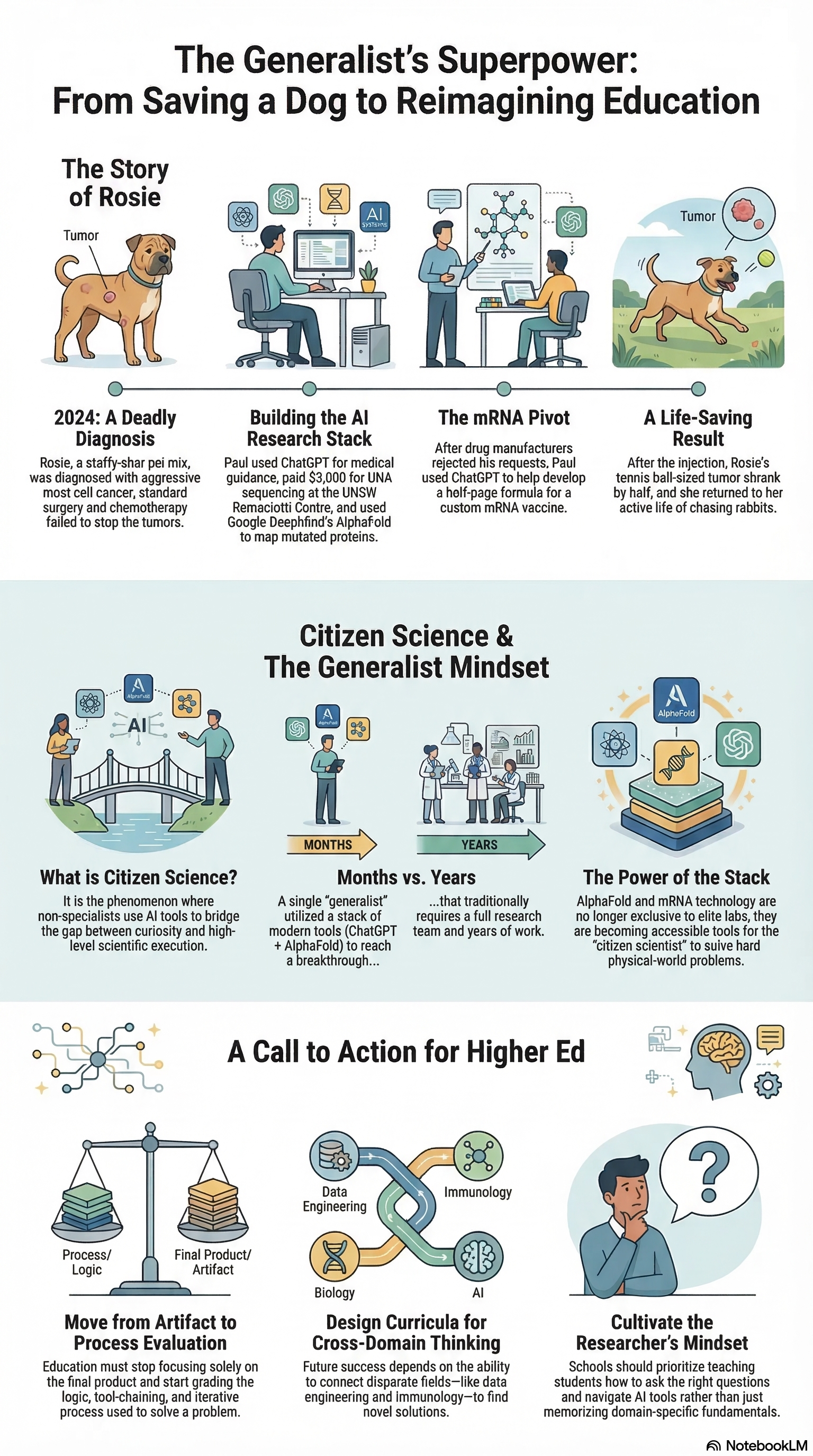
Infographic: The Generalist's Superpower — From Saving a Dog to Reimagining Education
What This Story Actually Teaches Us
My colleague Maddie Ludt first put David Epstein's Range on my radar, and Rosie's story is everything that book argues. A generalist, armed with curiosity, the right tools, and a willingness to cross domain boundaries, accomplished in months what would have taken a research team years.
The real superpower here wasn't AI. It was the mindset of someone who refused to stop at the edges of what they already knew.
That is exactly what we should be building in our students. And it raises an uncomfortable question: are our current programs and assessment practices designed to cultivate that kind of thinker, or to sort students by their ability to produce a polished artifact on command?
A Call to Action for Higher Education
If we are serious about preparing future leaders for this world, three shifts need to happen:
- Move from artifact evaluation to process evaluation. How a student thinks, iterates, and solves matters more than the final product they submit.
- Design programs that reward cross-domain thinking. The leaders of tomorrow will not succeed by staying in their lane.
- Cultivate the researcher's mindset. We want students who are always questioning what is currently known and asking whether it can be changed.
We say we want students who think critically, deeply, and creatively. Rosie's story proves that world is possible. The question is whether we are designing for it.
Why This Work Matters to CPCS
That question sits at the center of everything we are building here at the College of Professional and Continuing Studies. Our applied programs in organizational leadership are designed around exactly this premise — that the future belongs to leaders who know how to think, not just what to think. We have a long way to go, but I am glad we are asking the question.
I shared some initial thoughts on this over on LinkedIn — jump in if you want to continue the conversation.
Read the full article that inspired this post and see the step-by-step story of how Paul and Rosie pulled this off: The Neuron: ChatGPT Saved This Dog's Life
And if you want to stay ahead of what AI is doing across every industry, consider subscribing to The Neuron — it's one of the best AI newsletters out there, IMO.